Sustainable Textiles · Bathroom Care
Choosing Lower-Impact Fibers for Bath Mats and Rugs
A bath mat is a modest household object with an unexpectedly complicated job. It must meet wet feet without becoming a damp, slippery nuisance; it should feel pleasant, dry between uses, and survive the washing machine. Choosing one with sustainability in mind means looking beyond a reassuring fiber name to the whole story: how the material was grown, how the mat was made, what sits beneath it, and how long it is likely to stay in service.
Bathrooms are rooms of repeated small encounters with water. A mat absorbs the evidence of a shower, cushions the transition from tile to bare feet, and, if all goes well, returns to a dry and unremarkable state before the next person arrives. It is easy to treat this as a matter of softness alone. But softness is only one item in a longer list: absorbency, drying time, grip, construction, laundering, durability, and eventual disposal all affect whether a bath mat is a sensible choice for a particular home.
There is no single fiber that wins every comparison. Cotton can be absorbent and familiar, but a dense cotton rug may take longer to dry than a lighter weave. A synthetic mat may dry quickly or offer a useful grip, yet its composition and construction raise different questions. Hemp and linen bring distinct textures and qualities, but they are not automatic solutions if the mat is uncomfortable, difficult to wash, or unsuited to a humid room. The useful question is not simply, “Which material is greenest?” It is, “Which well-made material will work here, and will I care for it in a way that lets it last?”
That practical frame avoids two common traps. One is assuming that a natural fiber is always the most responsible option, regardless of processing, origin, or lifespan. The other is treating sustainability as a label that settles every question. A certification can offer valuable information, but it cannot tell you whether a thick rug will dry in your bathroom, whether its backing will remain sound, or whether you will still want it on the floor after a year of washing.
Begin with the room, not the label
Before comparing fibers, notice the conditions the mat will face. A spacious, well-ventilated bathroom is different from a windowless room where towels take half a day to dry. A mat used by one person once a day has a different workload from one shared by a household with children, guests, or frequent showers. The floor matters, too: smooth tile, textured stone, and vinyl do not offer identical footing. A large rug that looks settled on a dry floor may behave differently when damp.
Think about where the mat will sit and what it needs to do. A small mat placed immediately outside a shower is asked to catch a concentrated amount of water. A longer bath rug may be more about comfort and coverage, and its extra surface area can change how it dries. If the bathroom is poorly ventilated, a lighter, less dense construction may be more practical than a luxurious pile. A material that dries reliably can be a better fit than one that feels sumptuous for a few seconds and stays wet for hours.
Household routine is part of the specification. If a mat will be washed frequently, a simple construction with clear care instructions may be preferable to a complicated design that needs special handling. If it will be shaken out and hung after each use, you may have more flexibility. Sustainability is not merely a property of the object at the moment of purchase; it is also a consequence of how well the object fits ordinary life.
Cotton: familiar, absorbent, and varied
Cotton is a natural starting point in any guide to bath mat materials because it is widely used, easy to understand, and available in a range of weaves. It can feel soft underfoot and absorb water readily. Its everyday familiarity can also make care less mysterious: many cotton mats can be machine washed, though the label on a specific item should always take precedence over general assumptions.
But “cotton” describes a fiber, not a complete performance profile. A flat woven cotton mat, a looped towel-like mat, and a high-pile rug can behave quite differently. Thickness, density, yarn, and weave determine how much water a mat takes up and how quickly it releases moisture. A deep, heavy cotton pile may feel inviting, but it can hold more water and demand more time and airflow to dry. A flatter or more open construction may dry sooner, though it may feel less cushioned.
Organic cotton is grown under standards that restrict certain agricultural inputs and set requirements for processing and handling. A certification such as the Global Organic Textile Standard, commonly known as GOTS, can provide useful, structured information about a textile’s organic status and parts of its processing chain. It is more meaningful than a vague claim such as “eco-friendly,” but it should not be read as a promise that the finished mat has no environmental impact. Growing, dyeing, weaving, finishing, packaging, and transport still matter.
Consider the Temescal Organic Bath Mat as an example of how fiber and construction can be considered together. It is made from GOTS-certified organic Turkish cotton, woven in narrow channels, and described as absorbent and quick to dry while remaining lightweight. The channelled weave is relevant because performance does not arise from fiber content alone. For a bathroom where a thick, heavy mat would be slow to dry, a lighter cotton design may suit the routine better.
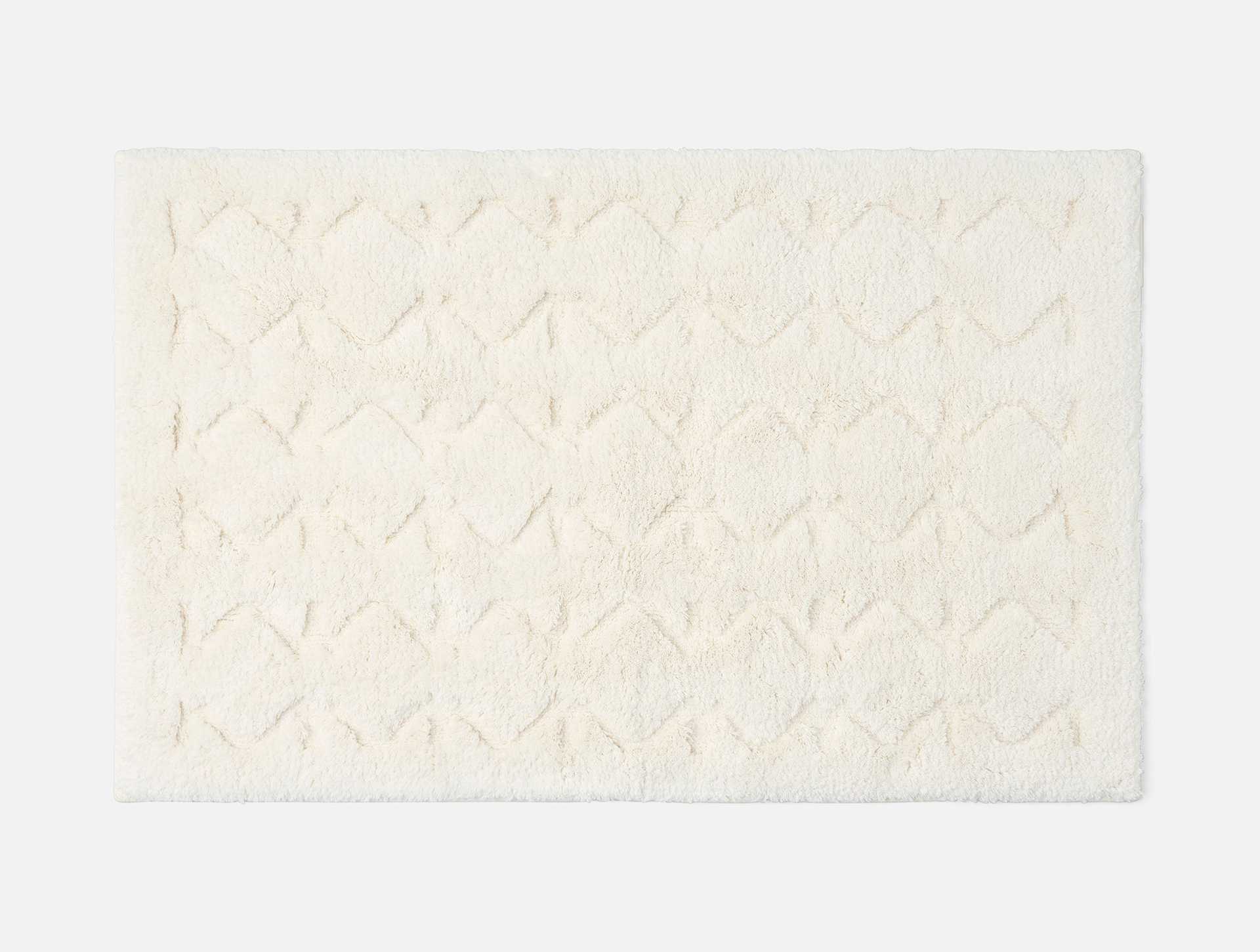
Another example is the Diamond Shag Organic Bath Rug, made from GOTS-certified organic cotton and woven in Portugal from cotton grown in India. Its alternating tuft heights create a dimensional surface, and it is machine washable. These details make it possible to assess more than the word “organic”: the origin of the cotton and the place of weaving are stated, the construction is described, and a care method is provided. Those facts do not answer every question about impact, but they give a reader something concrete to evaluate.
Hemp and linen: texture with trade-offs
Hemp and flax, the plant from which linen is made, are often considered in lower-impact textile discussions. Both can produce durable fibers, and their finished fabrics may have a crisp, textured hand rather than the plushness commonly associated with cotton. That can be appealing in a bath mat designed to dry efficiently or to provide a firm, lightly textured surface.
Still, a fiber’s agricultural reputation does not determine the environmental profile of every item made from it. Processing, dyeing, finishing, transport, and the useful life of a product matter. A hemp or linen mat that is rarely used because it feels too rough is not necessarily a better household choice than a comfortable cotton one that remains in use for years. Feel is not a frivolous consideration: an object must work well enough to avoid being discarded or replaced prematurely.
These fibers may also be blended with other materials, and the blend changes both performance and end-of-life options. A plant-fiber surface attached to a synthetic backing, for instance, is not simply a plant-fiber product. Read the full material description, not only the most prominent word on a tag. If a manufacturer provides information about origin, processing, or certification, weigh it alongside practical details such as washing and drying.
Synthetic fibers and the question of service life
Polyester, nylon, and other synthetic fibers appear in some bath mats, sometimes in the pile and sometimes in the backing. They can offer useful properties, including fast drying, color retention, or a surface designed to resist wear. Those advantages should be weighed against their fossil-fuel origins and the possibility that laundering synthetic textiles releases small fibers into wastewater. The scale and consequences can vary with material and washing conditions, so sweeping claims about every synthetic mat are not especially helpful.
Nor is “natural” a synonym for “long-lasting.” A mat that wears through quickly, loses its shape, or becomes unpleasant to clean may need replacing sooner than a synthetic alternative built to tolerate years of use. The more useful comparison is between actual products: what they are made of, how they are assembled, how they are cared for, and how long they are likely to remain functional in your particular bathroom.
Pay attention to the backing. Some mats use latex or other materials to reduce movement; others rely on weight, weave, or a separate non-slip layer. Backings can affect how a mat dries, how it responds to repeated washing, and whether different materials are bonded together in a way that complicates recycling or disposal. Follow the manufacturer’s instructions, and do not assume that a backing is safe for every floor surface. A secure mat is a practical safety consideration, especially where water regularly reaches the floor.
Construction may matter as much as fiber
When a label names a fiber, it tells only part of the story. Construction determines the way that fiber behaves underfoot and after a shower. Loop pile can feel textured and absorbent; a flat weave may be light and easier to hang; a shag surface may feel plush but take longer to dry. Tuft height, edge finishing, density, and the presence of a backing all contribute to durability and maintenance.
Inspect the edges and seams. A well-finished edge can help a mat keep its shape through regular use, while loose or fragile binding may become a point of wear. Look for an even surface and a construction that does not invite excessive snagging. If the product description identifies the weave or pile structure, treat that as useful information rather than decorative vocabulary. “Soft” and “plush” describe an impression; weave, weight, and care instructions help explain what the mat may be like to live with.
Weight can be informative, although it should not be treated as a universal quality score. A heavier rug may feel substantial, but it may also take longer to dry and be less convenient to launder. A lightweight mat may dry quickly but move more easily on some floors. Consider the complete combination: the texture you like, the grip the room requires, the available drying space, and the washing machine’s capacity.
Absorbency and drying time are a pair
In a bathroom, absorbency tends to get the attention. The mat should take water from wet feet rather than leave it standing on the surface. Yet absorbency without drying is an incomplete benefit. A mat that retains moisture may become unpleasant to use and harder to keep fresh, especially in a small room with limited ventilation. The goal is not to choose the mat that can hold the greatest amount of water; it is to choose one that handles the household’s ordinary moisture and dries in the conditions available.
Several factors affect drying: fiber, pile depth, fabric density, mat size, air movement, and whether the underside rests flat against a damp floor. Hanging a mat over a rail or drying rack after use can expose more of its surface to air. Ventilation helps, too. If you cannot hang the mat, a thinner construction may be easier to manage. These simple habits can prolong the useful life of a textile and reduce the chance that it remains damp between uses.
Claims such as “quick-drying” are most useful when read in context. A product may dry faster than a heavier alternative without drying instantly or under every condition. The bathroom’s humidity and airflow still matter. When possible, compare the listed construction and care details, and be realistic about the environment the mat will inhabit.
Care instructions are part of the purchase
A mat that can be cleaned without elaborate effort is more likely to be cleaned on time. Before buying, check the washing temperature, cycle, detergent guidance, and drying method. “Machine washable” is useful, but it does not mean that every mat belongs in a hot cycle or a high-heat dryer. Some cotton mats are best washed cold on a gentle cycle and tumble dried low; a particular item’s label should guide the decision.
Wash mats regularly enough for the household’s use, and let them dry fully between washes and between showers. Shake out loose debris, follow the care label, and avoid overloading the washer so the textile can move freely. If a mat has a backing, check whether repeated machine washing is permitted; the backing may require more careful treatment than the surface fiber. A product with straightforward instructions has a modest but real advantage: care becomes a routine rather than a project.
Care also influences environmental impact. A durable mat that is washed appropriately and kept in service for a long time may be a more considered choice than a nominally lower-impact one that fails early. Conversely, an item that requires frequent, energy-intensive drying may be poorly matched to a damp bathroom. The aim is not to turn laundry into a moral examination. It is to make a practical choice and maintain it sensibly.
Read claims with a little patience
Textile marketing has a vocabulary of easy reassurance: natural, clean, conscious, planet-friendly. Such terms can suggest a direction, but they do not necessarily explain how a product was made. Look for specifics: fiber percentages, country of origin, construction, certifications, care instructions, and whether the description distinguishes the source of the fiber from the place where the finished textile was woven or sewn.
Certifications are most useful when you understand what they cover. A standard may address organic content or particular stages of processing; another may focus on chemical management, social criteria, or chain-of-custody requirements. No one mark can report every relevant detail. If a claim is important to your decision, consult the certification body’s explanation rather than relying only on a badge or an adjective.
Transparency is not perfection. A product description that states where cotton was grown and where a rug was woven gives a clearer starting point than one that offers only broad environmental language. At the same time, disclosed origin alone does not establish a product’s total footprint. It is one piece of a larger picture that includes durability, care, packaging, transport, and what happens when the item can no longer be used.
A practical comparison checklist
When comparing Bath Mats & Rugs, keep the questions plain. They are more helpful than an attempt to identify a perfect fiber in the abstract:
- What is the full fiber content? Look for percentages and check whether the pile, backing, and binding use different materials.
- How is it made? Weave, tuft height, density, and edge finishing affect comfort, absorbency, drying, and wear.
- Will it dry in this room? Consider ventilation, how often the bathroom is used, and whether you can hang the mat.
- How will it stay in place? Assess the floor and the mat’s backing or grip, particularly in a wet area.
- Can I care for it easily? Check washing and drying instructions and consider how they fit your routine.
- Are sustainability claims specific? Look for named standards and clear information about materials and origin.
- Will I keep using it? Comfort, appearance, size, and maintenance all contribute to a longer useful life.
This checklist is intentionally less dramatic than the promise of a flawless “green” product. A bath mat is not a referendum on anyone’s character. The point is to make a well-informed choice that works in a real bathroom, where damp towels, a narrow drying rack, and the occasional forgotten load of laundry tend to matter more than a perfect abstract score.
Choosing for the long run
The most convincing lower-impact bath mat is often the one whose materials and construction match the demands of its setting. In a humid, low-ventilation room, a lighter weave that can be hung to dry may be more sensible than a deep pile. In a bathroom with ample airflow, a plush organic cotton rug may be comfortable and manageable. In either case, a credible material description, durable finishing, and workable laundering instructions make the decision easier to defend.
Buy the size you will use, not the size that looks impressive in a product photograph. Choose a texture you will enjoy stepping onto, but make sure it suits the amount of water it will encounter. Follow washing instructions, hang the mat when practical, and replace it when it is genuinely worn or no longer hygienic rather than because a trend has moved on. If the product’s components are easy to separate or its maker provides end-of-life guidance, that information may also help, though many household textiles ultimately need to be disposed of through local options rather than conventional fabric recycling.
Environmental responsibility can sound like a matter of grand gestures. In household textiles, it is often quieter: a careful comparison, a sensible care routine, a product that stays useful. Fiber choice matters, but it is not a verdict by itself. The most useful guide to a bath mat is the full account of what it is made from, how it is put together, and how it behaves after the shower is over.
The short version
Compare bath mats by more than fiber name. Cotton, hemp, linen, and synthetic materials each come with practical advantages and trade-offs, and construction can change their performance substantially. Check absorbency alongside drying time; inspect the backing and edges; read care instructions before purchasing; and treat certifications as useful, bounded information rather than a complete environmental report. A mat that fits the room, can be maintained easily, and remains in use is a strong place to begin a more thoughtful bathroom routine.